






Foreign Stocks Outperformed in 2025
Over the 20-year period ending in 2025, the stocks of large and mid-sized U.S. companies — represented by the Russell 1000 Index — produced an impressive average annual return of 10.94%. By contrast, the stocks of similar-sized companies in foreign countries returned just 6.22%.1

A large part of this performance disparity was due to the stronger U.S. economic recoveries after the Great Recession and the pandemic, along with the rise of massive technology companies that have provided a large percentage of U.S. market returns. Even so, foreign stocks outperformed U.S. stocks in seven out of the last 20 years, most notably in 2025, with a return of 32.55%, almost double the 17.37% return of U.S. stocks.2
One year or a trend?
The dominance of foreign stocks in 2025 was likely due to a combination of factors, including restrictive U.S. tariff policies, a weaker U.S. dollar, and because foreign central banks were more aggressive than the Federal Reserve in lowering interest rates. It’s too early to know whether this marks a fundamental shift, but some analysts believe foreign stocks — which remain significantly less expensive than U.S. stocks based on their price/earnings (P/E) ratios — still have plenty of room to grow and could experience strong performance over the next decade.3–4
On the other hand, those who remain skeptical of foreign stocks point out that large multinational U.S. companies provide global exposure, U.S. companies typically have higher profit margins than foreign companies, and U.S. technology juggernauts are unparalleled in foreign markets (although there are some large foreign technology companies).5
Holding foreign stocks is a standard diversification strategy, but some investors have backed away from it in recent years due to poor performance. If you are interested in adding a global dimension to your portfolio or expanding your current international holdings, here are some considerations.
A world of choices
One way to participate in global markets is by investing in mutual funds or exchange-traded funds (ETFs). In early 2026, there were about 1,270 mutual funds and more than 900 ETFs focused on global equities.6
International funds range from broad global funds that attempt to capture worldwide economic activity to regional funds and those that focus on a single country. Some funds are limited to developed nations, whereas others focus on nations with emerging economies, which may have greater growth potential but could be substantially more volatile, risky, and less liquid than the stocks of companies located in more developed foreign markets.
The terms “ex US” or “ex USA” typically mean that the fund does not include domestic stocks. On the other hand, “global” or “world” funds may include a mix of U.S. and international stocks, with some offering a fairly equal balance between the two. For any international stock fund, it’s important to understand the mix of countries and types of businesses represented by the securities in the fund.
Stock performance, annual total returns
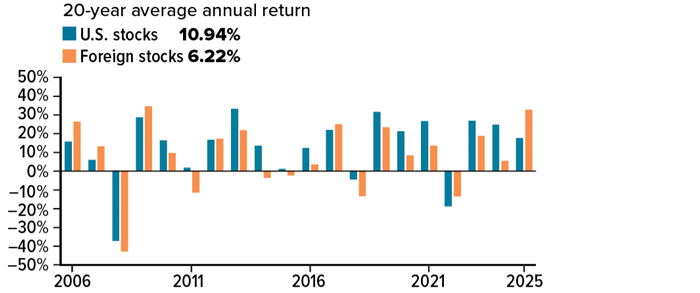
Source: London Stock Exchange Group, 2026, for the period 12/31/2005 to 12/31/2025. U.S. stocks are represented by the Russell 1000 Index, and foreign stocks are represented by the MSCI World ex USA Index. The performance of an unmanaged index is not indicative of the performance of any specific investment. Individuals cannot invest directly in an index. Rates of return will vary over time, especially for long-term investments. Past performance is not a guarantee of future results. Actual results will vary.
Additional risks
All investments are subject to market volatility, risk, and loss of principal. However, investing internationally carries additional risks such as differences in financial reporting, currency exchange risk, and economic and political risk unique to a specific country.
Diversification is a method to help manage risk; it does not guarantee a profit or protect against loss. The return and principal value of all stocks, mutual funds, and ETFs fluctuate with changes in market conditions. Shares, when sold, may be worth more or less than their original cost.
Funds are sold by prospectus. Please consider the investment objectives, risks, charges, and expenses carefully before investing. The prospectus, which contains this and other information about the investment company, can be obtained from your financial professional. Be sure to read the prospectus carefully before deciding whether to invest.